PITT, William , 1st Earl of Chatham
William Pitt the Elder (Kadwell Portfolio, Bromley Historic Collections) 15 Nov 1708 – 11 May 1778Prime Minister William Pitt married Hester Grenville of Wotton Hall, Bucks on 16 November 1754. An active politician, he wanted a home in the countryside but within easy reach of London. He leased and then purchased John Harrison’s house in Hayes [Hayes Place] in which he had stayed during the previous tenancy of Edward & Elizabeth Montagu. He tried to return to Hayes for at least a few nights each week. He had great plans to develop the house and its grounds. In 1756 Mrs Montagu received a report that ‘Mr Pitt is doing great things at Hayes, he has bought the house and the house hard by, and some fields. He has built a wall towards the public road 13 feet high. He intends to pull down the old house, and build another in the middle of the garden’. He commenced by buying and demolishing the cottages and an inn that were nearby and incorporated their grounds into his landscaped garden. He acquired some of the Glebeland. Buildings that spoilt his view were replaced and neighbours were asked, not always successfully, to cut down trees that spoilt his vista. Agreement was given in 1758 to move the road to Beckenham that he felt was too close to his house further to the south and in 1761 he wrote ‘from our Hovel of Hayes … new Hayes rises apace to … something I must ever love’. By this time Hester had given birth to three sons and two daughters. The entries for the two older sons, John (1756) and William (1759), are in the Baptismal Register for Hayes Church. It was also a time when Pitt was very involved in the successful conduct of the wars against France. In September 1759, General James Wolfe dined with him at Hayes the day before his departure to North America and the capture of Quebec. Over the following years many important political figures made their way to Hayes to discuss matters of state. In 1765 Sit William Pynsent died and left him his estate of Burton Pynsent in Somerset. He decided to move there and sold his Hayes estate to Thomas Walpole. He was appointed Prime Minister in 1766 and became Earl of Chatham. After two years, however, he decided to return to Hayes and eventually persuaded Thomas Walpole to sell Hayes Place back to him. It continued to need a large sum of money spent on it and his plans for the grounds expanded with more trees being planted and rivers diverted. A dishonest bailiff, tea smuggling, financial difficulties and ill health were some of the events to plague him in the early 1770s. One happy event was the marriage at Hayes Place, 19 Dec 1774, of his elder daughter Hester to Charles Lord Viscount Mahon. Chatham was always interested in American affairs, often disapproving of some of the government’s actions. He received several visits from Benjamin Franklin who, in 1774, bought him copies of the First Continental Congress’s address to the British people and the petition to the King. In 1778 he rose to speak in the House of Lords on the subject of American Independence but collapsed and was brought back to Hayes where he died on 11 May. Plaque to William Pitt, Earl of Chatham and his son William Pitt the Younger in Hayes Parish Church, unveiled on 30 September 1929 by Lady Stanhope (L.Smith) Blue Plaque unveiled in Hayes Street in 2009 See also: PITT, William the Younger
MONTAGU, Elizabeth née Robinson
Elizabeth Montagu (Kadwell Portfolio, Bromley Historic Collections 2 October 1718 – 25 August 1800‘Queen of the Blue Stockings’ and Society Hostess It was through Elizabeth Montagu’s contact with the poet Gilbert West of neighbouring West Wickham that she visited a house in Hayes (later Hayes Place), which her husband Edward leased for them in 1751 for three years. In September 1751, she wrote to her husband that she was going to Hayes ‘to enjoy quiet and my books till you arrive’. Her guests included Gilbert West and also William Pitt, for whom she arranged in 1753 for the delivery of a feather bed for his comfort. William Pitt decided to take over the lease in 1754 and that event had a great impact on the little village. Elizabeth remained in contact, visiting William Pitt and reporting on what was happening to the house and the family. Further information: ‘Queen of the Blue Stockings’, Ed. Emily J Climenson, Vols 1 & 2, London 1906 Brilliant Women, 18th-Century Bluestockings, Elizabeth Eger and Lucy Peltz, National Portrait Gallery 2008
KNOWLES, Mabel Winifred
Mabel Winifred Knowles (May Wynne) 1925 (Bromley Historic Collections) I Jan 1875 – 29 Nov 1949Author & Church Missionary Mabel Knowles was born in Streatham, the second daughter of Emma Letitia and William Knowles, a London Merchant banker. The family move to Hast Hill, a large Victorian mansion situated on the edge of Hayes Common, in 1895 when she was 20 years old. Her first book was published shortly after their arrival in Hayes and she continued to write popular, moralistic and instructive novel for both children and adults. Under the names of May Wynne, Mark Winchester, Lester Lurgan or Michael Kaye she wrote over 200 books and short stories. She used the proceeds to finance her missionary work in the East End. After her mother’s death in 1924, Hast Hill was sold. She moved to Maplin Road in the parish of St Luke’s, Victoria Docks, to continue her work amongst the poor. She continued to be supported in her efforts by members of the Hayes Parish Church who provided funds, opened up their homes and gardens for visits of groups from the Mission and provided relief parcels, particularly during the Blitz. In 1992 several of the children she had helped in the 1930s recalled their memories of this remarkable lady, a tall austere figure with long serge skirt and battered felt hat with her basket from which she would give out butter, cheese and eggs as required. She died from a heart attack on 29 November 1949 on her way to conduct a Mission Service and was buried in the family grave in Hayes Churchyard. She had made a lasting impact on so many lives and was known as ‘the Angel of Custom House’. Mabel Winifred Knowles ( S Merriman) Further information: Mabel Winifred Knowles 1875 -1949 “The Angel of Custom House”: Jean Wilson, Bromleage August 1993,(bblhs.org.uk) Who Was WhoOxford Dictionary of National Biography
Hayes Place
HAYES PLACEFrom 1600 to 1933 A new double house was built by Robert Hall opposite Hayes Church in about 1600 on the site of Asshleys. It marked the origin of Hayes Place, which in the following centuries would see many changes and would become the most important building in Hayes. Robert’s heir in 1624 sold the property to two brothers Edmund and Stephen Scott who also bought land to the south from Robert Ketchill and to the north from Christopher Allanson. Sir Stephen Scott and his family lived in the house. His brother Edmund died in 1639 and was buried in the chancel of Hayes Church. Stephen Scott later moved to Cheshunt but the house remained in his family’s ownership until sold by his son Stephen in 1697 to John Harrison, a feltmaker. The house had a number of tenants including Lynthwaite Farrant and Stephen Austen. In 1751 it was leased for three years by Mrs Elizabeth Montagu, Queen of the Blue Stockings, and in 1754 by William Pitt the Elder who would later become Prime Minister. By 1756 he had bought the property. Hayes Place Map 1766 He made major changes. Surrounding properties and more land were bought up. One of the houses was soon pulled down and the other was joined by a covered way to act as a sort of nursery for his children. By 1763 the new house was finished. It was later described ‘as square and has a high roof. The windows are small, and in the centre is a portico, with its top railed round to form a sort of balcony.’ There were still improvements to be made but when Pitt was bequeathed Burton Pynsent House in Somerset he decided to move and sold Hayes Place to Hon Thomas Walpole in 1766. Walpole probably employed the architect Robert Taylor to improve the building and when he was persuaded to sell the property back to William Pitt the negotiated price of £17,400 was substantially more than Walpole had originally paid for it. In 1778 William Pitt was taken ill in Parliament and died later on 11 May, in the bedroom with both west and south-facing window on the first floor. Hayes Place in the time of William Pitt, Earl of Chatham Hayes Place in the time of William Pitt, Earl of Chatham Pitt at Hayes Place During Pitt’s time at Hayes Place, the house saw many important visitors including General Wolfe of Quebec, Benjamin Franklin, the Duke of Cumberland, Lord Albermarle and Lord Cavendish as well as members of the family of his wife, Hester Grenville. It was also the place where his young son, also called William, was born in 1759 and he would become the youngest Prime Minister of England in 1783. The sale of the household goods and other effects of the Earl of Chatham started in November 1778 and lasted for six days. The catalogue detailed 23 bedrooms, a Drawing Room, Dining Room, 4 parlours, a Library, butler and housekeeper’s quarters as well as a Laundry & Washroom, A total of just over £1714 was raised. In 1785 James Bond, High Sheriff of Kent 1788, bought the estate but sold some of the land. Four years later he put the property up for sale. ‘An elegant spacious villa with stabling for sixteen horses, standing for four carriages, interior and exterior offices of every description: walled garden, fully cropped and planted, with a selection of the choicest fruit trees, pinery, peachery etc, and about one hundred and eleven acres of rich pastureland, surrounding the house. The house is a square pile of a brick building with stone dressings, seated on a spacious sloped Lawn …The Principal Entrance a neat Stuccoed Hall, paved with Portland Stone, surrounded by an Eating Parlour 22′ by 31′, Drawing Room 20’6″ by 31’, Music Room with Bow Window 23′ by 28′, Breakfast Parlour l8′ by 24′, Billiard Room 21′ by 30′, Ante Room, two Dressing Rooms, and circular Vestibule, the Ceilings 14′ high enriched Stucco Cornices, variegated Marble Chimney Pieces, the Walls uniformly hung with neat fashionable papers, clean deal floors and Mortice Locks to the Doors. An elegant geometrical stone staircase, light and easy ascent with Iron balustrades and mahogany handrail.’ The house was sold to George Legge, Viscount Lewisham for £10,500 but he had some difficulties in financing his mortgage and it was resold in 1798. He had excellent relations with the Rector Rev John Till who tutored his eldest son William. Land and house of Hayes Place sold to Lord Lewisham in 1789 Hayes Place was bought by Philip Dehany who moved to Hayes with his wife Margaret and daughter Mary. Sadly Mary’s fiancé, John Sinclair, 11th Earl of Caithness, committed suicide before they were married and she was allowed to adopt his niece Williamina Traill who was 14 years old when they arrived in Hayes. In 1832 she inherited Hayes Place and lived there until her death in 1862. Much care was lavished on the gardens and her greenhouses were used for growing various exotic plants. It remained in her family until 1880 but in 1867 was leased by Edward Wilson, founder of the Colonial Institute, who had recently returned from Australia. He was keen to try out the newly invented steam plough on his land and it was said that he introduced a number of exotic animals into the grounds. He died in 1878. The new owner, Everard Hambro, a banker bought Hayes Place in 1880 and employed the well known architect George Devey (1820- 1866) to improve the house. He altered the dining room and terrace, making a new entrance hall on the west side, and decorated the rooms. In 1890 the house was further extended and the opportunity taken to install an electric lighting system. In 1912 the mansion was described as built in two linked wings of stock brick and stone. Hayes Place from the air (Bromley Historic Collections J8-248) Hayes Place Library (Bromley Historic Collections) Sir Everard died in
Hast Hill
Hast Hill, Baston Manor Road From 1885 Hast Hill, built on land on the edge of Hayes Common belonging to Sir John Farnaby Lennard of Wickham Court, occupied a commanding view with 12 acres of land. It was a large house with 16 bedrooms, a library, billiard room, dining room and large drawing-room. It was first sold in 1887 to Charles Challenor Smith, a retired merchant, whose seven children in the 1891 Census were aged from 1 to 18, the youngest born in Hayes. The Knowles Family Four years later, in 1895, he left Hayes and it was leased to the widow of merchant banker William Knowles. In 1901 Mrs Emma Letitia Knowles lived there with two of her daughters Mabel Winifred, age 26, Evelyn 21 and six resident servants. Mabel Knowles, also known as the author May Wynne, wrote many of her books here from 1895. She became a prolific writer of fictional and improving works for both adults and children. Hast Hill was bought by Mrs Knowles in 1915. World War 1 During the First World War, Hast Hill was used at first for the reception of convalescent and wounded soldiers. In 1916 two rooms were set aside for an annexe to the Canadian Military Hospital at Bromley Court. From 1924 to post-war Hayes Mrs Emma Knowles died in 1924 and the contents of the house were put up for auction. The house was sold to F H Rogers. The following year it was resold to Granville McAlpine, son of Robert McAlpine and a partner in his father’s construction company. Three years later he died at the age of 45 and his widow sold the property to H T King who lived there until 1956. Permission was given for the property to have a change of use to the offices of Pattullo Higgs, agricultural merchants. The residential character of the house and grounds had to be maintained. Forty years later Honeygrove Developments bought the house and it reverted to residential use and was converted into luxury apartments. Hast Hill before conversion
Post War 1946 to Today

Post War Hayes In the immediate aftermath of the war, the main task was to remember the fallen, rebuild damaged houses and energise the community. Remembering the dead The task of organising the inscription of the names of the Hayes civilian and service casualties on the War Memorial was begun and completed in 1950. It was another ten years before there were sufficient funds to build an extension to the Village Hall which was also planned as a Memorial to those who had given their lives in the Second World War. Memorial Stone, Hayes Village Hall Housing Damaged houses needed to be repaired and new houses built for those whose homes had been totally destroyed, There was a shortage of raw material, strict restrictions on the size of properties and also limited licences for basic supplies such as bricks. To meet the immediate problem of the shortage of homes: Prefab houses were built in Meadway in 1946 and were not replaced by townhouses until about 1967. The Army Camp on Hayes Common was converted into temporary housing in 1948 and was occupied until 1955. Frances & Ken Clark outside their home, Unit 19 Hayes Common Camp around 1951-2 (BBLHS) Bromley Council took over the remainder of the Hayes Place Estate and planned to build 337 houses, 12 old people’s dwellings and six shops with maisonettes. The development took place between 1950-1955. In 1961 a Public House, The Beacon, opened on a vacant green space and survived until 2010 when it became part of a private redevelopment of the old people’s flats and the surrounding area. The Beacon (G Wright) In 1950 the construction of 66 flats in Kemsing and Larkfield Closes was finished. Kemsing Close (M. Lee) Change in use of major houses Hayes Court in 1946 was bought by the Electrical Trades Union. It ceased to be used as a Trades Union Headquarters in about 2010 and in 2012/13 was sold for development. Houses were built in the grounds and the first was occupied in 2015. The house was converted into flats and first occupied in 2017. Hayes Court Offices, 1987 Modern development at Hayes Court, 2019 Hayes Grove was purchased in 1951 by the King Edward VI Hospital Fund and became a home for retired nurses until 1980. Three years later it became Hayes Grove Priory Hospital. Hayes Grove Hayes Grove staff & supporters 1980 Hast Hill became used as offices by Patullo Higgs from 1957 until 1996 when it was bought by Honeygrove Development and converted into luxury apartments. The lodge and two cottages were also refurbished. Street House was converted into flats in the 1970s and part was also used as consulting rooms, now a dental surgery Baston Manor was made into flats in 1952 and the outbuildings became cottages. The Oast House in the 1950s was divided into two properties and later, in 1968, the outbuildings were converted into Webb’s Cottage. Ivy Cottage remained as a private dwelling but in 1954 some of its grounds were used to build six distinctive properties in Warren Road. Grandfield’s Nursery damaged by the V2 in February 1945 was not rebuilt but the site was acquired to build a Roman Catholic Church. The Village Store and the houses on the opposite side of the road could not be repaired. Eventually, approval was given for neo-Georgian houses, Nos 7 -11 West Common Road. Longcroft was already partly demolished at the outbreak of World War II. Pickhurst Primary School was opened on its grounds in the 1950s. Demolition and new housing Prickley Wood was pulled down and replaced with a close of 12 houses in 1955. The coach house was demolished in the 1970s and replaced with maisonettes. Hawthorndene was sold In 1962 by Basil Binyon. It was pulled down and houses were built in Hawthorndene Road and Hawthorndene Close, Holland Close and Holland Road. Hawthorndene site after the demolition of the house ( H King) Hawthorndene Close under construction (M Lee) Glebe House was replaced in 1963 by Isard House, an Old People’s Home, which survived until 2016. Isard House then became part of a housing development and was also demolished. Isard House 1974 ( G Wright) Barnhill ceased to be a school and was sold to A J Wait & Co in 1964. The main house was pulled down and private housing was built on the grounds. In Bourne Way two Victorian detached houses were replaced by blocks of flats, Meycroft in 1969/70 and later 12 flats were built at Woodgrange Court in place of Woodgrange. Forge House was built for Dr Jack Hopton at 3 Pickhurst Lane in 1934. Thirty years later a group of houses were built on the grounds creating Forge Close. In 1985 Forge House was replaced by a new doctor’s surgery and sheltered accommodation called Hopton Court. Demolition of Forge House (R Manning) The greatest change in the original village of Hayes perhaps occurred in George Lane with both the demolition of older properties and the creation of new homes. Georgian Close was created in the 1960s. The Rookery Estates, which owned the majority of the land, built four estate houses, Nos. 33-40 George Lane, in the 1950s They were sold in 1990 and an additional house was built behind them. Some of the very old cottages, such as Nos. 13-15, were replaced in the 1970s by detached properties. The neighbouring cottages (9-11) survived and in 1997 were sold and made into one property. Bath Cottages 9 – 15, George Lane, the furthest one demolished 13 – 15 George Lane Five of the 1920s’ Utility bungalows were replaced by a terrace of 16 houses between 1966 and 1971. Permission for the demolition of the last utility bungalow and the building of a pair of semi-detached houses and a detached house was given in 2011. A bungalow at 87 George Lane was demolished and replaced with two semi-detached houses. Earlier the land of Street House was sold to open up the access from Hayes
The Second World War
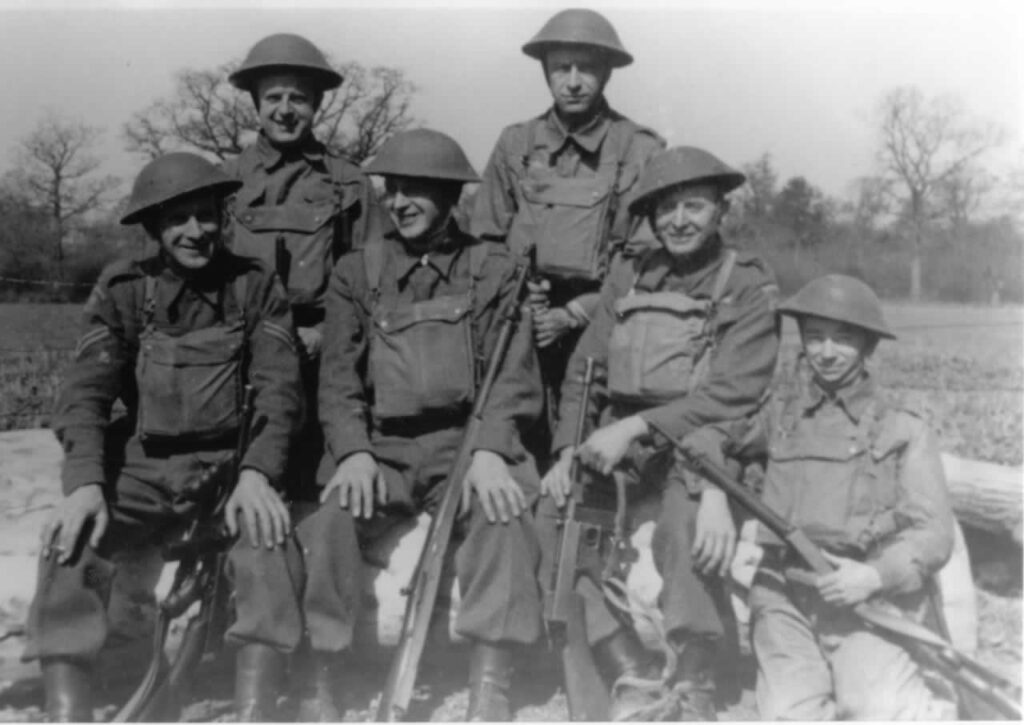
World War II 1939-1945 The fear was growing that Britain would again be involved in a war. As early as 1935 the Government had sent a circular to county councils setting out the need for local authorities to form a Civil Defence organisation. Bromley Borough Council began to implement plans as part of the London Civil Defence region. The HVA took an active interest and its small sub-committee set up to watch over the official arrangements for Hayes was absorbed into the Council’s Air Raid Precautions (ARP) Committee in 1938. In spite of complaints that it was all proceeding too slowly a great deal had been achieved by the time war was declared on 3 September 1939. The Old Rectory was designated as a damage and casualty centre and a sub-fire station. The fire appliance was kept in Hayes Garage which was across the road. The Old Church School was set up as a first-aid centre after the Borough Council in June 1939 approved the expenditure of £2000 to convert it. It would be manned 24 hours a day. The Clubroom was later fitted out with showers for a gas decontamination centre. Gadsden, which had been bought by the Kent County Council in 1928, had not yet become a school and it became the centre for ARP activities. Gas masks were assembled and distributed in 1938 from here and the Old Church Schools. It became the base for local ARP rescue units. Later, in May 1940, it was also used as a Reception Centre for a large number of refugees arriving from the Low Countries. Gadsden Preparing for War By October 1938, 240 had volunteered for training either in the Old Church Schools or the Village Hall.Drills were held and a major exercise took place at George Lane School in April 1939 to test the first aid and communication teams. Later, in June, there was a mock air raid in which the ambulance service was called to Gadsden where several people had been hit by fragments of anti-aircraft shells, there were injured people by the Station, incendiary bombs needed to be extinguished and in the open space at Pittsmead and Chatham Avenue, a high explosive bomb defused. Hayes Boy Scouts were amongst the casualties who, with a label tied to their coats giving details of their injuries, were sent to various parts of the village to await the rescue squads. Training continued and it was all useful practice for what was to come. A Metropolitan Police air raid siren was installed in March 1939 at the junction of Hayes Street and George Lane next to a blue police box. ARP arrangement instructions were issued in July 1938 to all householders. Shelters, both public and private, started to be organised. The Borough Council designated the basements of four shops in Station Approach, Nos. 42 to 48, as shelters. Slit trench shelters were constructed in the grounds of the Old Rectory and Knoll Park for 200 and 150 people respectively. Shelter sign in Station Approach ARP instructions side 1 ARP instructions side 2 The War Office requirements for Hayes Common Negotiations began in May 1939 with the War Office who wanted to use Hayes Common as part of the defence of London. The Army later clarified its needs as an anti-aircraft site for 4 heavy mobile guns near the SE corner of the junction of Baston and Croydon Roads, with 4/6 huts placed to its west. The guns would require concrete foundations and a prepared roadway. An agreement was reached and construction work began for the guns and 6 huts. Negotiations also took place to mount a searchlight battery on the Common near the junction of Croydon Road and Hartfield Crescent. By August it was in place. Interestingly the formal agreement was not signed until April 1941 by which time there had been some changes in the number of guns. The Civil Defence arrangements for the area were confirmed by the Bromley Borough Council on the outbreak of war. Hayes was District No. 5 and had five wardens posts situated at Socket Lane, Courtlands Avenue, Chatham Avenue, Knoll Park and Gadsden. On 3rd September the District Warden was William Melville and 86 men and women were listed as wardens, although the personnel changed as the war progressed. Bromley Control Centre (Miss D Timms) ARP & AFS Fire watch was an important ARP task. Considerable training was given to deal with fires caused by incendiary bombs which might fall and be trapped in roofs and gutters etc. In 1940 the training was put into action, the number of the fire watching parties increased to 40 by the end of the year and was organised in squads of ten or more so that three people could be on duty each night. Incendiary advice on Wills’ Cigarette cards Incendiary advice on Wills’ Cigarette cards In addition, there were volunteers for the AFS and the Light and Heavy Rescue sections of the ARP.Water supplies were augmented to cover any disruptions to mains supplies by building Emergency Water Supply tanks. One, which held about 100,000 gallons of water, was sited at the junction of The Green and Pittsmead Avenue and another at the junction of Station Approach and Pickhurst Lane. Outbreak of War There was an immediate increase in the preparations for the defence of Hayes as soon as the war was declared. Many householders had either Anderson or brick-built shelters installed. Shelters were set up in schools but some, like the one at Hayes Council School, were not completely finished by April 1940. Plans were put in place for the evacuation of some children and families to safer areas but the arrangements for children to go to Canada ceased after the torpedoing in September 1940 of the SS City of Benares on which ten-year-old Michael Brooker of Bourne Vale was one of the casualties. In 1941 indoor Morrison shelters could be purchased. Conscription was introduced and all men aged 18 – 41 had to register
The 1920s and 1930s

The inter-war years were a period that witnessed the increase in the population of Hayes to around 6,500 in 1939. It was the result of an almost tenfold increase in the number of houses from 222 in 1921 to approximately 2,150 in 1939. These changes were caused by the decision of many property owners to agree to sell their homes to building developers. Of the large houses only the Oast House, Baston Manor, Hast Hill and Hayes Grove remained in private ownership, although a small piece of the garden of Hayes Grove was sold to the builders Tyson & Harris Ltd to build Grove Close. A number of the major houses were used for a different purpose: Schools were set up at Hayes Court 1919 by Miss Katherine Cox Barnhill 1932 by Robert Hilary Smith Baston House 1933 by Marian & Margaret Stafford Smith The Metropolitan Police Sports Club’s official opening took place at the Warren in 1935. Coney Hill became a Home for Disabled Young People run by the Shaftesbury Society in 1935. Housing Development The Howard family who owned Pickhurst Manor were the first to sell pieces of land for development and within ten years the manor was demolished.1926 – part of the land was sold to Sidney Gilchrist Thompson for the building of the Hayes Hill Estate.1931 – George Spencer purchased the house and the rest of the land.1936 – Pickhurst Manor was demolished and by 1939 new houses had been built in Pickhurst Lane (Nos. 31-99 & 92-126) and in Hilldown Road, Courtlands Avenue, Hayes Hill (even Nos.), Hurstdene Avenue, Briar Gardens, Dene Close, Hurst Close. Development of Pickhurst Manor lands by 1931 Over 20 houses were also built in the 1920s at the northern end of Hayes Lane within the parish boundary. The death of Sir Everard Hambro in 1925 led to the sale of Hayes Place and its land to William E Agg-Large in 1930.1931 – part of the estate was sold to Henry Boot & Sons Ltd of Sheffield with plans for 901 houses and included a parade of shops, Premier Parade, opposite the church.1933 – The mansion was demolished. Development of Hayes Place Estate by 1935 1934 – development of the area to the south of Hayes Place was almost complete. It covered the Knoll, Ridgeway and Hayes Garden and four builders were involved: Bleach and Skipper, J C Derby, Keen & Sons and W.A.Jones. Hayes Place Estate Map showing the proposed development of the Knoll, Hayes Garden and Ridgeway 1936 – Boot sold to Williams & Phillips Ltd and T & H Estates Ltd the part intended as Stage 2 of the development. It became Bourne Vale (47-99), Trevor Close, Chatham Avenue, Constance Crescent and part of Mounthurst Road.1938 – W.I. Cook & Co of Beckenham bought land on the northern border of the estate and started to build houses in Mead Way, Hazelmere Way and Heath Rise but this was interrupted by the war.1939 – By this date ‘Boot’ houses were completed in Alexander Close, Everard Avenue, Cecil Way, Cherry Walk, Dartmouth Road, East Way, Hambro Avenue, Husseywell Crescent, Montcalm Close, Northbourne, Oakmead Avenue, Pittsmead Avenue, Sackville Avenue, South Way, Stanhope Avenue, Stuart Avenue, The Green, Wolfe Close and parts of Bourne Vale, Chatham Avenue, Hayes Lane, Hayes Street, Kechill Gardens, Mead Way, Pickhurst Lane and Southborne . Pickhurst Mead was included in the Hayes Place Estate sale in 1931. 1934 – The mansion was demolished in March.1933/34 – Bleach & Skipper built the Pickhurst Green houses and by 1936 had built houses in Pickhurst Lane. 1937/39 – the houses in Pickhurst Mead were built. Warren Wood was sold for development in 1934/5 to Durable Buildings Ltd who built 1-25 and 2-26 Holland Way, Abbotsbury Road, Sandiland Crescent and Westland Drive by 1939. The house was probably demolished by 1936. In 1930 James Frost, the owner of Glebe House, died and the house and land were put up for sale. In 1932 the land was sold separately to Morrell (Builders) Ltd. The house remained unoccupied. The following year Burwood Avenue, Glebe House Drive and Hayes Wood Avenue to its northern boundary with the grounds of Street House were developed. Glebe House Drive Sir Henry Payne lived in the Nest, which he renamed Redgates, from 1921 until his death in 1931. In 1936 it was bought by W W Courtenay Ltd, the house was demolished and Redgate Drive constructed. Five houses were built before the outbreak of the Second World War. Longcroft had been bought by John Thomas Hedley in 1892 but he did not live there after Phyllis Broughton, a Gaiety Girl, rejected his offer of marriage. After he died the house was sold. The demolition of the house started in 1938 but was not finished when war broke out. Twelve semi-detached houses fronting the east side of Pickhurst Lane were built by 1939. 1920s – Longcroft sale board Other new housing appeared in George Lane including six bungalows built under the Hayes Public Utility Society in 1925 and 12 houses known as Hookfield Cottages in 1927. Bromley Council bought land from the Norman family to build Nos 37-51 George Lane in 1936 and the following year Nos 53-83. Hawkswood, George Lane Land in Baston Road saw development on the west side where houses were built by L T Pryor in 1933/34 and the following year land, originally part of the gardens of Glebe House, was developed by Bleach & Skipper. In 1938 S G Gee built the houses adjacent to the Rectory Grounds. Shops Hayes Street 1930s – Premier Parade of shops was built by Henry Boot & Sons Ltd (Nos.18-38) Station Approach 1930s – Both the east and west side of Station Approach were developed by different builders and also the area around the railway station which extended into Bourne Way. By 1939 there was plenty of choice with larger stores such as the South Suburban Cooperative Society, Home & Colonial, David Grieg Ltd, and MacFisheries. There
1901 to 1921

Situated opposite the church Hayes Place remained at the centre of the village. Its owner Everard Hambro maintained his friendship with King Edward VII and in 1908 was made a Knight Commander of the Victorian Order. He supported the church, paying for the recasting of the three oldest bells in 1900 to complement the three new bells he had given in 1882. He liked to modernise, was one of the first to have electricity in his home and he enjoyed the luxury of the new form of transport – the motor car – which was replacing horse drawn carriages. Pickhurst Mead was leased to the motor racing driver Arthur Huntley-Walker. Unfortunately, a house fire in 1905 destroyed the library and another fire in 1909 saw substantial damage both to the house and to fourteen of Huntley Walker’s cars, which included a 90hp Darracq built for the 1909 Grand Prix. He left Hayes soon after this event. Baston & Pickhurst Manors both saw changes with the death of Captain Alfred Torrens at Baston in 1903 and of widow Leonora Devas of Pickhurst Manor in 1909. Henry Norman of Gadsden died in 1905 and the property was bought by James Railton. Hawthorndene also changed hands after the death of widow Mrs McLennan in 1896. George Reader, a solicitor, was followed by Sir Steyning William Edgerley KCVO and in 1913 John Lee-Warner was in residence with his wife Blanche, a son and two daughters. Henry Wellcome, co-founder of the pharmaceutical company Burroughs & Wellcome, came to the Oast House after his marriage to Syrie Barnardo in 1901. They moved into the Nest after the birth of their son in 1904 but separated in 1911 and moved away from the village. With the increase in the number of people in Hayes there were more facilities. A large shed was converted into a building called the Gymnasium in which a variety of social activities such as dances were held and the Hayes Brass Band practised. It stood in the yard adjacent to Harrod’s, a grocer’s and general store, which was almost opposite the site of the Rosary Church today. The Hayes Village Club and the Hayes Church Social Club organised entertainments. The Hayes Cottage Gardeners’ Association (started in 1891) remained active. A Rifle Club was formed in September 1908 and the Rifle Range was situated on the northern boundary of the cricket field at Barnet Wood Road. The school remained under the headship of William Plant but after the Education Act of 1902 was supervised by the Education Committee of the Kent Education Authority. A branch of the Union of London & Smiths Bank opened one morning a week for 1½ hours, there was a post office in Baston Road, two post boxes in Hayes and a telegram office at the Railway Station. Hayes in 1914 The Great War 1914 – 1918 The start of the war in August 1914 and the encouragement for young men to fight for their country resulted in a rush to join up. By Christmas 1914 over half of the eligible men in Hayes had enlisted, in addition to those already serving in the forces. The total number of men to serve who had a Hayes connection whether by birth, employment or because their family lived in Hayes came to 196. Of these 47 are known to have been casualties. Some moved elsewhere after the war and their details have not yet been uncovered but in the front of the Great Bible in Hayes Church the names of 103 men are written who served during ‘the Great War and by God’s Providence returned home.’ Men who returned home safely from First World War (front of Hayes Church Great Bible) Gallantry awards were received by: Albert Batten MM Walter Batten DCM Geoffrey Charles Devas MC Harry Granville Lee-Warner DSO and MM William Mitchell DCM & MM Lionel Norman MC Arthur Valentine Taylor DCM Albert Batten MM Walter Batten DCM Some of the wounded from the battlefields were cared for in a number of local Red Cross hospitals: Hayes Grove had room for 20 patients Warren House provided 55 beds until the death of Sir Robert Laidlaw in 1916 Hast Hill made room for 7 patients and later it became an extension to the Canadian Convalescent Hospital at Bromley Park Hotel 88 Hayes Road offered 4 beds VADs at Hayes Grove (Miss M Fuller) Many Hayes women and some men joined one of three Voluntary Auxiliary Detachments: Kent 50, Bromley Common, Hayes and Keston Kent 52, Bromley Kent 82, West Wickham commanded by Gillian Lee-Warner who lived at Hawthorndene Other women such as Winifred Morris, Elsie and Elizabeth Trevor nursed in military hospitals in France near the front lIne. There were many different efforts in Hayes to help the war effort including: Fundraising, concerts and fetes Knitting socks, gloves, scarves, hats for the soldiers Food parcels Writing letters Empire Day Certificate 1915 In addition, women took over some of the men’s jobs on the land and in the shops and post office. Mary Harrod, Postwoman There were food shortages and rationing was introduced towards the end of the war. The schoolboys were encouraged to grow vegetables. In 1916 they harvested 280lb of potatoes and 200lb of onions. Village School headmaster, William Plant, and the gardening class Hayes became part of the East Sub-Command of the anti-aircraft defences set up to protect London. Only two bombs fell on Hayes, one in Station Road [Bourne Way] and another in woodland near Hartfield House. Major C.E. Prince, who was involved in the development of ground to air and air to air communications lived at Five Elms towards the end of the war. A telephone pole was set up near his home and assisted with his work at Biggin Hill in the Wireless Experimental Establishment. Finally, the war ended on 11 November 1918. Victory Cup given to Hayes school children in 1918 Beatty’s signal on Victory Cup given to Hayes school pupils 1918 Almost £464
Victorian 1837 to 1901

The last quarter of the nineteenth century witnessed major changes in the village of Hayes but life throughout the century was affected by the developments occurring elsewhere in the country. The gap between rich and poor was marked and there were periods of unrest. There was still no mains drainage but Hayes Place was one of the first homes to have electricity and a few gas lamps had been installed in the main village. Communications improved with the setting up of a village Post Office and in 1882 the railway from Hayes to West Wickham was opened. In 1841 there were 105 houses and the population had fallen to 490 from 504 in 1831, mainly as a result of an increase in the number of deaths in the village in 1840. There were 14 burials between October and December and six of the eight in November were children under nine. Most of the men were employed as labourers although there were also skilled craftsmen working in the village forge and carpenters’ workshops. William Ledger, for instance, was involved in the building of the greenhouses for Charles Darwin at Down House. Extract from the tithe map showing the Church, Rectory, Hayes Place and the upper and lower village The parish covered 1249 acres of which 281 were arable, 664 pasture, 120 wood, 44 ornamental, 50 gardens and 200 Common lands. Hayes was one of the first areas to register in 1868 a scheme of management under the Metropolitan Commons Act of 1866, although struggles between villagers asserting their rights still caused conflict. Although the owners of Baston Manor and the tenants at Pickhurst Manor continued to play a part in the community it was the arrival of the banker Everard Hambro at Hayes Place that significantly impacted the village. He became the owner of most of the land that formed the main village. The Sun Inn and Alma Arms which had emerged in the middle of the century were replaced with the New Inn close to the new Hayes Station. He developed his own mansion and built new lodges, improved the workers’ cottages pulling down the ones below the George Inn and replacing them with ‘Model Cottages’. Poplar Row to the south of the school was replaced with the terrace known as St Mary Cottages. Poplar Row (G W Smith) St Mary Cottages Three cottages on the edge of the Common were combined to create Ivy Cottage for two of his sisters-in-law, and Hayes Grove was extended. These properties all survive and are today nationally listed as is the church whose size almost doubled with the building of a north aisle in 1856 and a south aisle in 1878. The eastern part of the parish remained mainly farmland owned by the Norman family of Bromley Common, who let the various farms, Hayesford, Hayes Street and Baston, to different tenants over the century. Working on the land remained one of the main sources of employment for the villagers, but many also worked as domestic servants in the new large houses built in the last thirty years of the century. By the end of the century, 87 new homes had been built, two were under construction and the population had increased to 838. The new houses included: Gadsden (G W Smith) Glebe House (R. Frost) Main houses in 1880 Fifteen villas also appeared in Hayes Road, part of which was within the Hayes Parish at the time. A Parish Council was elected under the Local Government Act of 1894 and replaced the long-established role of the Vestry which now reverted to just an ecclesiastical function. Notable People: Lord Sackville Cecil of the Oast House, engineer, chairman of Exchange Telegraph Company Alexander and his son Alexander George Findlay of the White House, map & chart engravers, FGS Henry Hallam, Pickhurst, historian Sir Everard Hambro, banker, Hayes Place Thomas John Hussey, Rector of Hayes 1831-54, astronomer & theologian Anna Maria Hussey, mycologist Arthur Fitzgerald Kinnaird, Pickhurst, became President of the Football Association John F Mclennan at Hawthorndene from 1875, a Scottish lawyer and ethnologist John Everett Millais stayed at the George in 1852 while preparing sketches for his painting of ‘The Proscribed Royalist’ Frederick Henry Norman, banker of Hayes Court, and his sons Montagu (later Governor of the Bank of England) and Ronald (later chairman of the BBC) Henry John Norman of Gadsden, director of London & Westminster Bank Williamina B Traill of Hayes Place Charles Simpson RA, an artist, spent holidays at Pickhurst Manor with his grandparents Edward Wilson of Hayes Place, founder of Colonial Institute 1868 Charles Simpson’s painting of ‘The Cow Field at Pickhurst’ References: Major sources are the parish, local government and Hayes Common Conservators’ records, newspapers, directories, maps and other documents held in Bromley Historic Collections and in the records of St Mary the Virgin, Hayes. Also: London Metropolitan Archive 1017, Eliot Family Papers HMSO, Return of Owners of Land 1873-6 G.W. Norman, Autobiography, Bromley Historic Collections Charles Kadwell, History of Hayes, 1835 Edward Walford, The Environs of Greater London, 1884 Lavinia Smiley, The Frasers of Castle Fraser, 1998 Charles Simpson, The Fields of Home, 1948 T C Woodman, The Railway to Hayes, 1982