Stuart 1603 to 1714

By the end of the Stuart period, the development of Asshleys had changed the social structure in Hayes. There were now three important houses and gradually Baston and Pickhurst Manors would become less significant. New houses like Benebroke in 1639 and Homefield were constructed although Mr Bradgate’s ‘very good house’ was demolished. The 1664 Hearth Tax recorded 48 households of different sizes which suggests a population of around 200. There were two inns, the Adam and Eve almost opposite the church and the Rose belonging to the Rudland family – where the George Inn stands today. A small Church House was given to the Parish by Robert Hall in 1606 and was used as the poor or workhouse during the century. In the 1620s Robert Hall’s main house [Asshelys] was bought by Stephen Scott and his brother Edmund, who died in 1639. Sir Stephen, described on his tombstone as a gentleman pensioner to King Charles I, had difficult decisions to make when the English Civil War between Parliament and the King broke out in 1642. The wealthier families with land in Hayes had to weigh up the situation. Some like Arnold King, a Royalist, who owned property in the north of the Parish lost their lands and had to wait until the 1660s to recover their property. Baston was bought by Cuthbert Burbage (Burbidge), better known for the building with his brother of the Globe Theatre in London and his connection with William Shakespeare. On his death at Baston in 1636 his daughter Elizabeth inherited. Cuthbert Burbage and his wife died in Hayes but were buried at Shoreditch in London. Cuthbert Burbage burial entry (Hayes Church Register) In the struggles in the 1640s, her husband George Bingley retained his position as a government auditor although in 1643 he was imprisoned for a short while for non-payment of £200 demanded that year by Parliament. At the end of January, he was ‘respited until he received money due by the State for his services. Taxation was heavy and a burden on the community. Several Hayes men asked for confirmation of their payments including the Rector, Christopher Monckton, who remained during the troublesome times until his death in 1652. 1644 Tax Receipt (TNA SP28/158/130) George Bingley died in 1652 and Baston descended through the family to Elizabeth Lloyd who on her death in 1693 left £3 a year from the rent of Redgate Farm to teach the poor children of the village to read. In the same year Matthias Walraven, a brewer from Rotherhithe bought Pickhurst from John Hall, who had purchased the land from Thomas Cooper. The Jackson family had ceased ownership in 1642. A Malthouse was developed there. After the execution of King Charles I in 1649 Sir Stephen Scott left Hayes for Cheshunt where he died in 1658 but he was buried in Hayes Church. His eldest son John inherited and the property remained in the hands of the family until 1697 when it was sold to John Harrison, a felt maker. The land of Sir Humphrey Style in the north of the parish became a subject of considerable controversy after his death in 1659 and its inheritance for her life by his widow Dame Hester Style. In a legal case in 1661 William Style claimed that she and John Scott were harming both the ancestral home in Langley Park and the estates in Beckenham, West Wickham and Hayes. William had to wait until her death ten years later before he could inherit. Various tenants farmed the land north of Pickhurst Green. Sir Humphrey Style (P Knowlden) Main houses in Hayes by 1714 References: Edward Hasted, The History and Topography of Kent, reprint 1981 Canon H.P. Thompson, History of Hayes, 1935 Livery Records, Worshipful Company of Grocers, Guildhall Patricia E Knowlden, The Town of Bromley in Kent and the Great Rebellion, BBLHS 2001 C Kadwell, History of Hayes, Bromley Historic Collections Eliot Family Papers, London Metropolitan Archives, Acc 1017
Tudor 1485 to 1603

Within the village, there were few changes in the number of houses until towards the end of Queen Elizabeth I’s reign. The population may have increased slightly but price rises, poor harvests and outbreaks of plague or ‘sweating sickness’ made life hard for the villagers. The number of beggars or wanderers seeking help increased. More of the woodland was managed and several men, including Robert & William Shott, John Hoare and John Humphrey, were described as ‘colliers’ [charcoal makers]. Baston Manor continued to be significant in the time of the Tudors. In 1499 a new hall was built and in renovations in 1813 fragments of some of the earliest paintings in oil on wood were discovered which may have lined the walls. (See illustration above. The panels are now in the Society of Antiquaries) John Heydon inherited Baston on his father’s death in 1504 and was knighted at the coronation of Henry VIII in 1509. He spent most of his time at Court or on his Norfolk estates. The dissolution of the monasteries by Henry VIII resulted in Sir Percival Harte being granted Orpington Manor with its sub manor of Baston in February 1541. It was to him and not the Prior of Christ Church Canterbury that Sir John Heydon paid his manorial dues. His great-grandson William in 1580 sold John and Samuel Lennard the manor but there were difficulties with the legal titles and a protracted dispute with the Calthorpe (Calthrop) family who also claimed it. Baston Manor subsequently descended through the Calthorpe family who recognised the Lennard’s right to the manorial dues. The ownership of Pickhurst was acquired by Sir Robert Rede, Chief Justice of the Common Pleas in 1506 and remained in his family until the end of the century when it was sold to William Jackson. At the end of the 16th century, an important change occurred when Robert Hall, a wealthy London grocer started to buy property in Hayes and had a new ‘double house’ built opposite the Church. It was this house, Asshleys, that would eventually become the most important one in Hayes. Main houses in Tudor Hayes Hayes Church also witnessed changes caused by the religious upheavals of the century which affected the traditional form of worship. Christopher Sharpearrowe complied with Henry VIII’s command in 1534 that the clergy obeyed him and not the Pope. His successor William Dryland did not survive the return to pre-Reformation worship under Queen Mary I but Robert Garrett, appointed in 1554, remained as minister of Hayes in the reign of Queen Elizabeth I until he died in 1566. His successor John Hoare, 1566-84, was also more traditional than the next minister, Samuel Darcknoll, the first married priest in Hayes, who recorded the names of his nine children in the register of baptisms. Register of baptisms, marriages and burials in Hayes Church started to be recorded in 1539. Revd John Hoare, Rector of Hayes 1566-1584 Burial Register 1539/1540 References Archbishops’ Registers, Lambeth Palace Library Bernard Davis, Notebooks Vol 2, Bromley Historic Collections Manorial Records U312 M13-M22, Centre for Kentish Studies Mother Mary Gregory: Wickham Court and The Heydons, Archaeologica Cantiana 1963 Mother Mary Gregory; The Purchase of Wickham Court by the Lennards, Archaeologica Cantiana 1964
Medieval to 1485AD
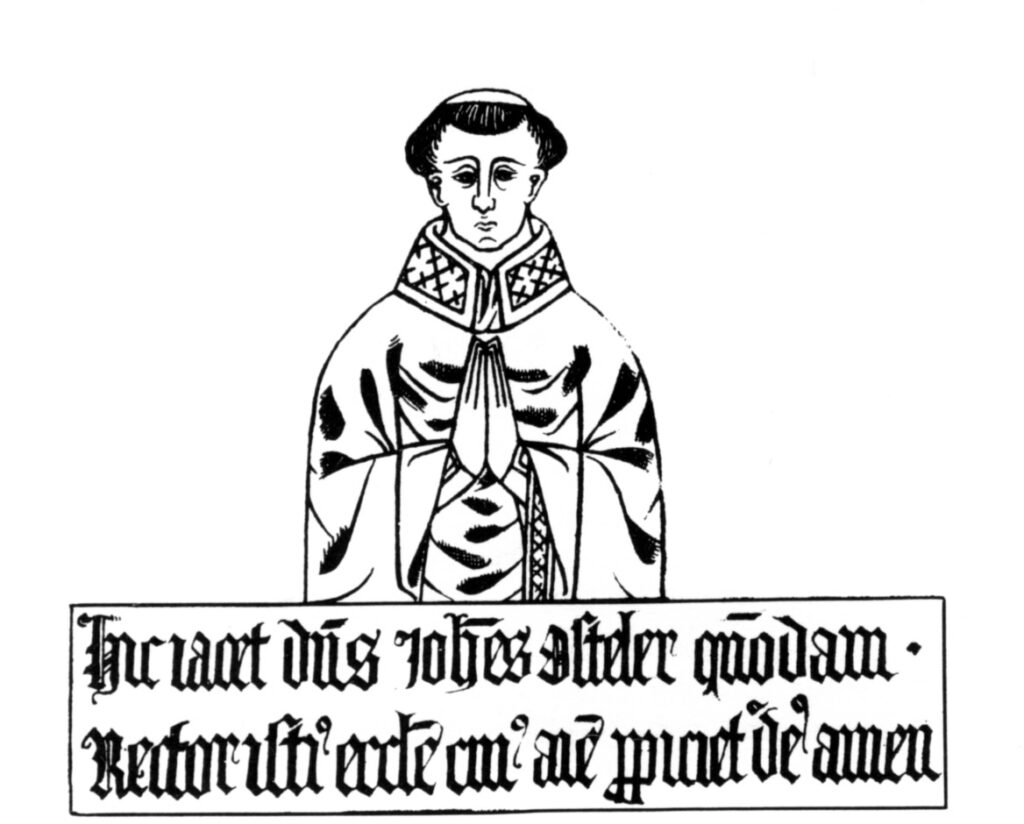
More written records are available in the medieval period and they reveal that Hayes developed as a small community. Both churches, manorial and legal records help us to find out about the early village. In 1301 a tax roll provides the names of 26 householders who had sufficient goods to be rated and it is estimated that the population numbered about 140. The wealthiest man was Master John de Bastane who farmed his land and paid manorial dues to his overlord. The feudal system of landholding meant that most of the land of Hayes was owned by the Monks of Christ Church Canterbury who established the Manor of Great Orpington with its subsidiary manors of Baston and Pickhurst. Baston Manor stood at the top of the steep scarp of the Blackheath beds overlooking the ‘Coney Hill’ Valley. It was isolated from the rest of the settlement and was probably originally a defensive position commanding a fine view to the west. Its owners managed the majority of the land in Hayes and by 1477 there were 17 tenants. Medieval Baston Feudal ownership The Manor of Baston passed from the Esthalle family of the Cray Valley to Otto Grandison, a valued friend and companion of King Edward I. After his widow Beatrice’s death the property was in the hands of Geoffrey Newenton who also owned Wickham Manor and he sold to another local family the Squerys. At the end of the medieval period, it was owned by Henry Heydon, a wealthy nobleman and lawyer with several large estates in Norfolk, including Baconsthorpe Castle. His wife Ann was the great aunt of Ann Boleyn, Henry VIII’s second wife. He lived for part of the year at Wickham Court, which he also owned. Pickhurst Manor in the north of the Parish had fewer tenants and in the early medieval period both Holy Trinity Priory, founded by Queen Matilda in 1141, and the Abbot of Holy Saviour, Bermondsey, in the 13th century, also owned some land in the north of Hayes for which tenants paid dues. The owners of Baston and Pickhurst Manor did not necessarily live in Hayes but relied on tenants to provide them with an income. The manorial courts record village activities, the appointment of the ale-taster, the settlement of disputes, and in 1450 provide the names of nine husbandmen pardoned by the king – William Robert, John Hever, Richard Shot, Richard Aleyn, Alan Nashe, John Aleyn, Hugh Kechyll, William Frenshe and Simon Kechyll who had taken part in Cade’s rebellion. The villagers were affected by some of the major changes of that time but chiefly by the Black Death in 1349, which seems to have reduced the population by half. Slowly the population recovered. By 1485 more land in Hayes had been cleared. A few houses had appeared along the track to Bromley and there were small groups clustered around Pickhurst Green, the edge of Baston Hethe and near the Church, which was situated midway between the manors of Baston and Pickhurst. The church was an important focus in the village. Gifts were left to it and brasses survive to two ministers in the late medieval period John Osteler (died 1461) and Sir John Andrew (minister 1462-1479). Early Medieval settlements in Hayes References: A descriptive catalogue of ancient deed in the Public Records Office, Vol 1, Vol V1 PRO 1894 Bernard Davis, Notebooks Vols 1 -10, Bromley Historic Collections Charles North, Calendar of Kentish Wills: 1384 to 1559, 1890 R A L Smith, Canterbury Cathedral Priory, 1943 Orpington Court Rolls, Canterbury Cathedral Archives, John Thorpe, Registrum Roffense, 1798 Rochester Priory Records, Centre for Kentish Studies Lewis Duncan Leland, Testamenta Cantiana, KAS 1906
Prehistoric to Saxon

Palaeolithic (to 8,000BC) The remains of reindeer, mammoth, woolly rhinoceros, horse, hand axes and flints were discovered in the 1880s in a deep pit in Hayes. It was located close to Tiepigs Lane and was a source for extracting gravel for use on roads and during the construction of the railway to Hayes which opened in 1882. It has now been filled in and is covered by housing. Flint blades, scrapers and hand axes have also been found on Hayes Common and flint tools in Hayes Lane and Alexander Close. Palaeolithic flint 1897 (C Kadwell History of Hayes) Palaeolithic flint (Bromley Historic Collections) Mesolithic (to 4000BC) An axe, core, flint blades and scrapers have been found on Hayes Common near Baston House School and a tranchet stone axe at Hayes Street Farm. Mesolithic flint Neolithic (to 2000BC) Numerous flints and pottery have been found on Hayes Common, in the Gravel Pits, in the Pickhurst area, in Hayes Lane and near Hayes Court. When a large and significant Neolithic settlement was excavated near Baston Manor by the West Kent Border Archaeological Group in 1964 the finds included flints, knives, blades, scrapers, axe and arrowheads. Amongst the 225 pottery sherds, it was possible to identify 50 different vessels. Excavating Neolithic site (B. Philp) Bronze Age (to 700BC) Evidence of human activity continues in the succeeding centuries when our ancestors started to use metal tools. Flints, pottery sherds, loom weights and fragments of quernstones exist from a farmstead excavated to the south of Hayes Court. It dates from between 1000 to 700 BC and suggests that late Bronze Age farmers were rearing sheep and growing corn in Hayes. A bronze socketed winged axe has also been discovered in the north of the parish on land formerly part of Fixted Farm. Iron Age (to 43AD) There are very few Iron Age finds but pottery was discovered during the building of Hayes Primary School, George Lane, in 1935 and near Barnet Wood when a gas pipe was installed in 1964. It has been claimed that the 500-metre linear earthwork to the east of Hayes Court may be from the late Iron Age period but no dateable finds have been recovered to confirm this suggestion. Roman (to 410AD) There are considerable signs in the areas around Hayes of settlement in Roman times but at present in Hayes evidence is limited to: a Roman Bathhouse near Baston Manor excavated in 1964 pottery found in Malling Way where excavations indicated a small farmstead in 1993 a cremation urn discovered at Hayes Court and a small cup and a bronze coin of the Emperor Antoninus Pius (AD 138-161) in 1923 300 coins from between AD 296 and AD 309 were found in a pottery vessel near Ravensbourne School in 1953 Roman tiles were inserted in the walls of Hayes Church. Hayes Court cremation urn (Kadwell Portfolio, Bromley Historic Collections) Roman bath house (B Philp) Roman tile in a wall of St. Mary’s Church Roman cremation urn and coin of Antonius Pius Saxon (to 1066AD) A bronze sword ring, part of a pommel, was found in Hayes Lane in 1934 and is the only Saxon artefact discovered to date in Hayes. By the 11th century, charters reveal that much of the land belonged to the monks of Christ Church Canterbury but no evidence has yet been found of whether Hayes was occupied at the time. References: Mark Newman, A survey of the Archaeology of the Parish of Hayes, Kent 1983 B J Philp, Excavations in West Kent, 1960 -1970 Brian Philp, The Discovery of Archaeological Sites at Hayes, Kent 1960 – 1997 M.C.Watts Anglo-Saxon Charters of Bromley, Kent, Bromley Local History Number 4, 1979