‘I like Hayes as it is’, was the view of most residents of Hayes in 1926. The parish was home to around 1000 people across 234 households including 50 Victorian villas in Hayes Road. For 45 years Sir Everard Hambro had shaped almost every aspect of village life. From his 43 room mansion, Hayes Place he oversaw an estate that included 73 properties, Hayes Place Farm and Fixteds Farm., the George Hotel and the New Inn. His death in February 1925 had left villagers very anxious about the future.
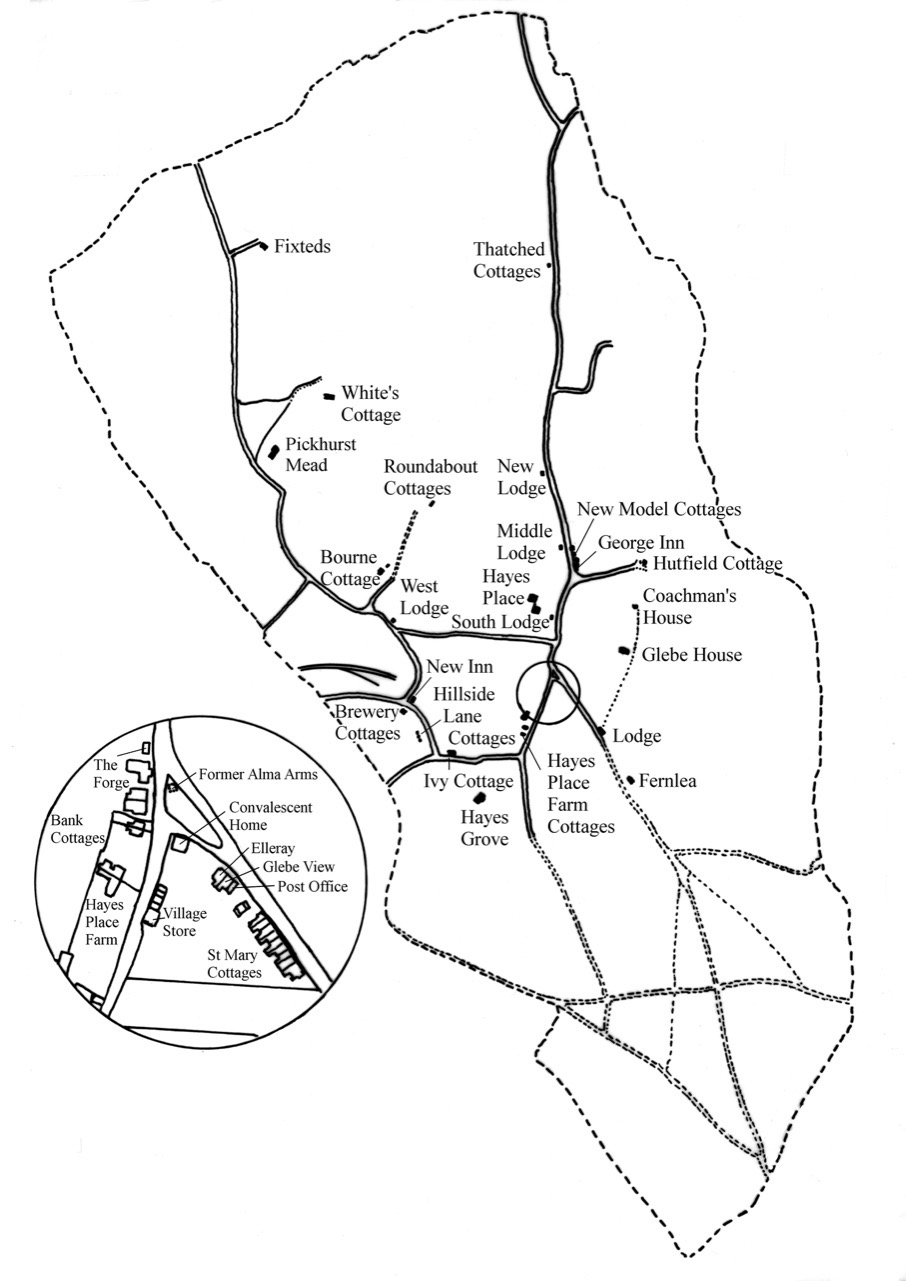
With his heir, Sir Charles Eric Hambro, deciding not to live in Hayes, rumours spread quickly. Would Hayes Place be let to a wealthy banker or merchant? Would the estate be broken up for development? Would tenants face rent increases or even eviction? The uncertainty hung heavily over the village.
Sir Eric Hambro’s Decisions and Early Property Changes
Despite the speculation 1926 saw only gradual changes
* Glebe House was sold to James Frost, who had tenanted the 23 room property since 1919. In October 1926 he applied for planning permission for an addition to his home.
* Pickhurst Mead with its 28 rooms was leased in September by Edward Thomas John for five years at £300 annually.
* The New Inn remained tenanted by Edith Davey.
* Negotiations for the George Hotel continued until sold to Watney’s in 1927.
* The Village Stores & two adjoining cottages were leased to Edwin Tidbury for 21 years.
The weekly rents of most cottages remained the same. At the year’s end it was still uncertain whether any cottages would be demolished.
Proposed Development: Hayes Place Land
Building companies were increasingly active around Hayes and eager to secure land for new housing. Sir Eric Hambro began exploring the creation of a Hayes Place Estate which required approval from the Bromley Rural District Council (BRDC), and the Ministries of Health and Transport.
A proposed road layout – including several public open spaces – was submitted in March and finally approved in November 1926. Sewerage costs were agreed but many details still required negotiation.
Building Elsewhere in the Parish
Hayes Lane
*F A Wastell applied to build three detached and two semi-detached houses
*Mr Parker put in proposals for two detached houses
* Miss L Terry submitted plans for a bungalow
Hayesford Park
* sewer planned for Beadon Road and plans to join Beadon and Cameron Road
Hayes Hill Estate
*Capt Sidney Thompson continued developing the infrastructure of his estate on the western edge of the parish. He agreed to contribute land for the widening of Tiepigs Lane
Other changes included:
* outbuilding application at Baston Manor for Henry Legge
* a pavilion & shed at Greenways for Arthur Collins
*wireless experiments at Hawthorndene, home of radio pioneer, Basil Binyon, who resigned as Director of the BBC in 1926, and in the same year was appointed Chairman of the Institute of Engineer’s Wireless Section.
*Granville Ramage McAlpine, racing driver and engineer purchased Hast Hill
Working Class Housing and Overcrowding
Housing shortages were acute. Some families lived with several generations under one roof, others faced worse conditions. In early 1926 two families, each with three children, were living in a partitioned farm shed at Fixteds Farm, Pickhurst. After Council intervention, sanitary improvements were made and they were given temporary permission to stay until November.
Efforts to improve housing included:
* Renewed pressure on the BRDC, particularly by Parish Councillors Percy Jones and Mrs Lilian Thompson, to build long promised housing in George Lane on a site purchased from the Norman family in 1920. The Parish Council wanted any new homes to be restricted to Hayes families.
*The Hayes Public Utility Scheme, led by Mrs Thompson, enabled working men to build and own their own homes.The plots cost £40 and four of the six proposed bungalows were completed by the end of 1926. The bungalow for Charlie Harrod (76 George Lane) was built by Sale & Mansfield and cost £572 including the fencing. It was sold for almost ten times that amount to Marsden Developments Ltd in 1967. Other bungalows were built by Henry Disdale who lived at 82 George Lane. Costs often surprised new owners – cess pit connection, sewer and road charges.- but the security of ownership made the challenge worthwhile.
Employment Opportunities in 1926
Building construction offered one opportunity for work but most of the villagers were employed on the farms or in the gardens of the local large houses. In 1921 over a third of the men worked on the land. Key farms included:
* Hayes Place Farm, where W F Skilton was awarded a milk licence in March 1926
* Pickhurst Manor Farm, where R G Campbell had a milking herd of up to 20 cows
* Hayes Farm specialised in Guernsey cows. Sidney Rose the farm bailiff, achieved 2nd Prize in the Kent Clean Milk Competition.
* Hayesford Farm, run by Daniel Dutton
* Baston Farm, in 1926 the land was still farmed by Douglas Haldeman although he had moved to Gadsden to live.
Wages were modest. At Fixteds ploughman John Knight was paid £2.20 a week and farm labourer, Howard Brittan, earned £1.67.
Domestic service was also significant. Over 140 women and men were employed as cooks, housemaids, butlers, domestic servants and chauffeurs. Most were resident in the large houses.
Men also worked on the railway as signalmen or clerks.
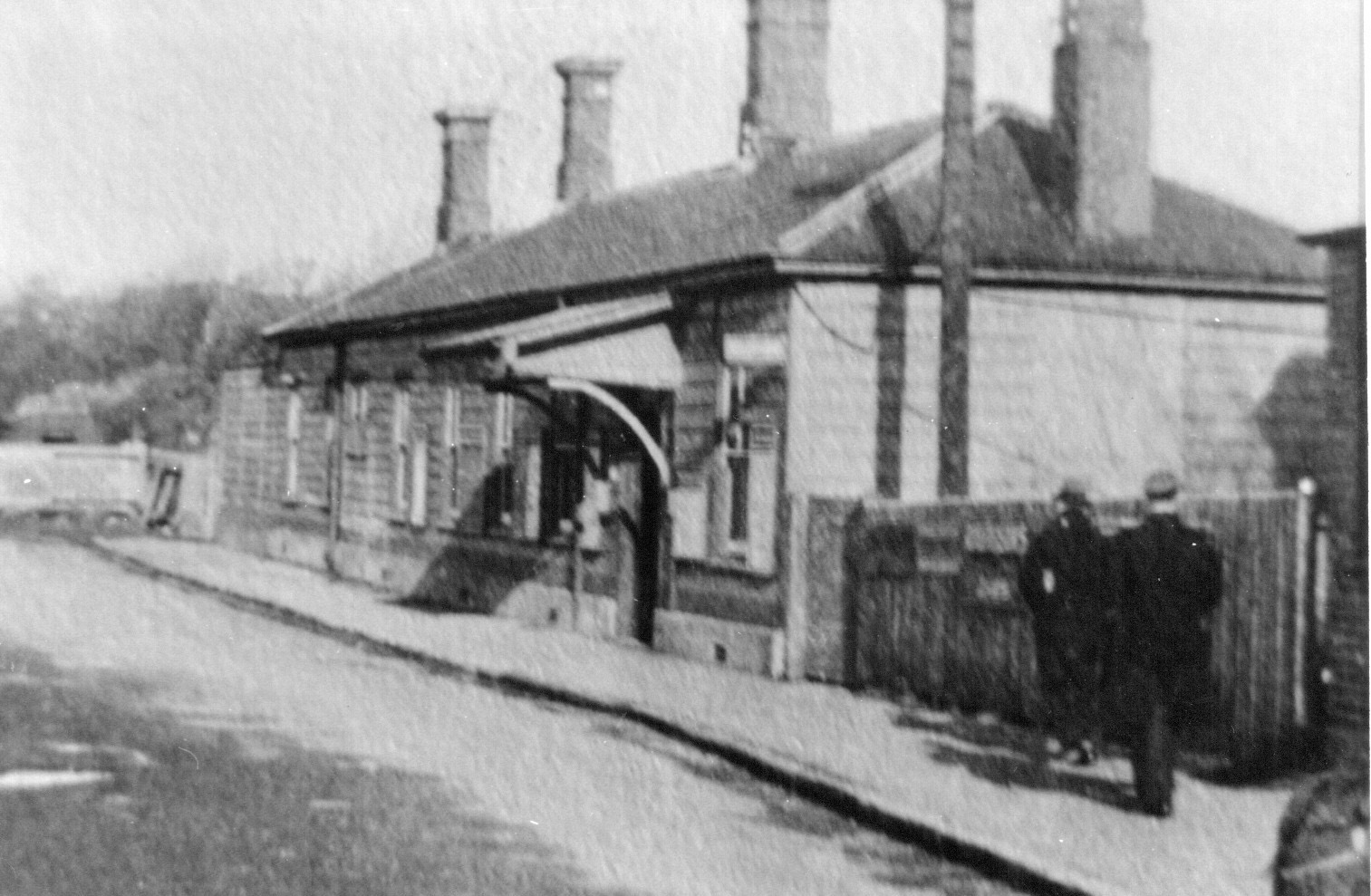
The electrification of the railway in 1925 opened up further opportunities for employment in London. Bank, bookkeeping, costing & insurance clerks, shorthand typists and telephonists used the service as well as stockbrokers, bankers, accountants, solicitors and merchants. The full suburban electric timetable to Charing Cross and Cannon Street from Hayes came into force on 28th February 1926.
The General Strike in May 1926 caused national disruption, but Hayes maintained a strong community spirit praised by the rector Canon H P Thompson. Unemployment relief work was carried out at Pickhurst Green in November. National restrictions on gas & electricity for lighting, heating & power introduced after the Strike were removed at the end of November.
Parish Council
At the time the Hayes Parish Council (HPC) met monthly and kept watch on developments in Hayes. It was also responsible for appointing the Common Conservators, fixing the Common Rate, and making recommendations to the BRDC on topics such as drainage, road safety and fire precautions.
Hayes Parish Councillors were elected in 1925 when there were 14 candidates for 7 places
- Mrs Laura Smail of Warren Wood, a district councillor, topped the poll
- Lt Colonel George Fulcher
- Matt Torrens, a stockbroker of Hayes Grove,
- Mrs Lilian Thompson, the rector’s wife,
- Ernest Poynter, the local newsagent at the Walnut Tree, [Hayes Street]
- Percy Jones, a gardener at Hayes Court
- Emmanuel Mansfield of George Lane, who in 1921 was described as an out of work scaffolder, was a successful builder by 1926.
- Mrs Honor Joyson was co-opted on Laura Smail’s resignation in February. The Clerk was retired headteacher William Plant.
- The different backgrounds ensured a wide range of viewpoints.
Key issues in 1926:
*housing
*Hayes announced as a fire sub station in March, fire hydrants, hose coverage, equipment storage at Rectory and use of rectory telephone in case of fire.
*rat infestation around 10 St Mary Cottages
*footpath maintenance and overhanging trees
*white lining dangerous bends
*provision of a seat by Councillor Mrs Thompson in Hayes Lane, installed in November.
*Lt Col. Fulcher and William Plant appointed in June as parish representatives on the new Rating Committee set up under the Ratings and Valuation Act of 1925.
Bromley Rural District Council
Hayes representative, Mrs Laura Smail was replaced in April by Edwin Sydney Poynter.
The BRDC dealt with planning, sanitation issues, housing and highways. In 1926 it approved:
*a new school hall at Hayes Court School.
*Music and Dance Licences to the George Inn and Hayes School
*Petroleum licence to Mr Hack at the General Stores
*Water supply certificates to new properties.
Concerns included:
*refuse collection problems, open cart and waste disposal
*fire arrangements
*flooding from the River Ravensbourne into Hayes Road
*flooding down Fox Hill & Fox Lane on to property of Greenways. A legal case under way by end of the year.
*setting up a valuation committee on which E S Poynter was a member.
Hayes Community Council (HCC)
In December 1925 it was agreed that a Village Council should be set up consisting of representatives of all Hayes organisations. Its first meeting on 3 February 1926 set out its constitution, membership structure and a one shilling (5p) subscription. The meeting was attended by 17 out of a possible 20 members:
The Rector Church
W Joynson Parochial Church Council
S D J Mortimer Choir
P Jones Parish Council
E M Preston Conservators
Mrs G Preston School Managers
Mrs K Burman School
Mrs H Joynson Women’s Institute
Miss V Thompson Girls Friendly Society
Mrs L Hamlyn Social Club
C F Wood Men’s Club
A R Spink Football Club
Mrs L Thompson Girl Guides
A Robjant Band
Lady M Payne Nursing Association
W Edwards Cubs & Scouts
F Keech Cricket Club
Proposed Village Hall
A new village Hall was a priority and the Hayes Community Council reviewed six potential sites.
The preferred early choice was land near the Village Stores. When this fell through attention shifted to the land behind the Forge near the school. By the end of 1926:
*Trustees had been appointed
*Designs considered, including a £4,500 proposal by Mr Burchett and a simpler design for a hall 50 feet x 30 feet with a dressing room, stage and kitchen.
*Fund raising events were underway.
It was the following year that this site was rejected because of potential road charges and one next to the Church was adopted.
Community Life and Local Organisations
The Rector, Revd Canon H P Thompson, strongly encouraged the building of a Village Hall which he recognised would strengthen community life.
*The Hayes Social Club & Men’s Club flourished
*The Women’s Institute formed a successful Drama Society in 1926
*The annual crowning of the London May Queen took place on Hayes Common. Nancy Winter was the Hayes May Queen.
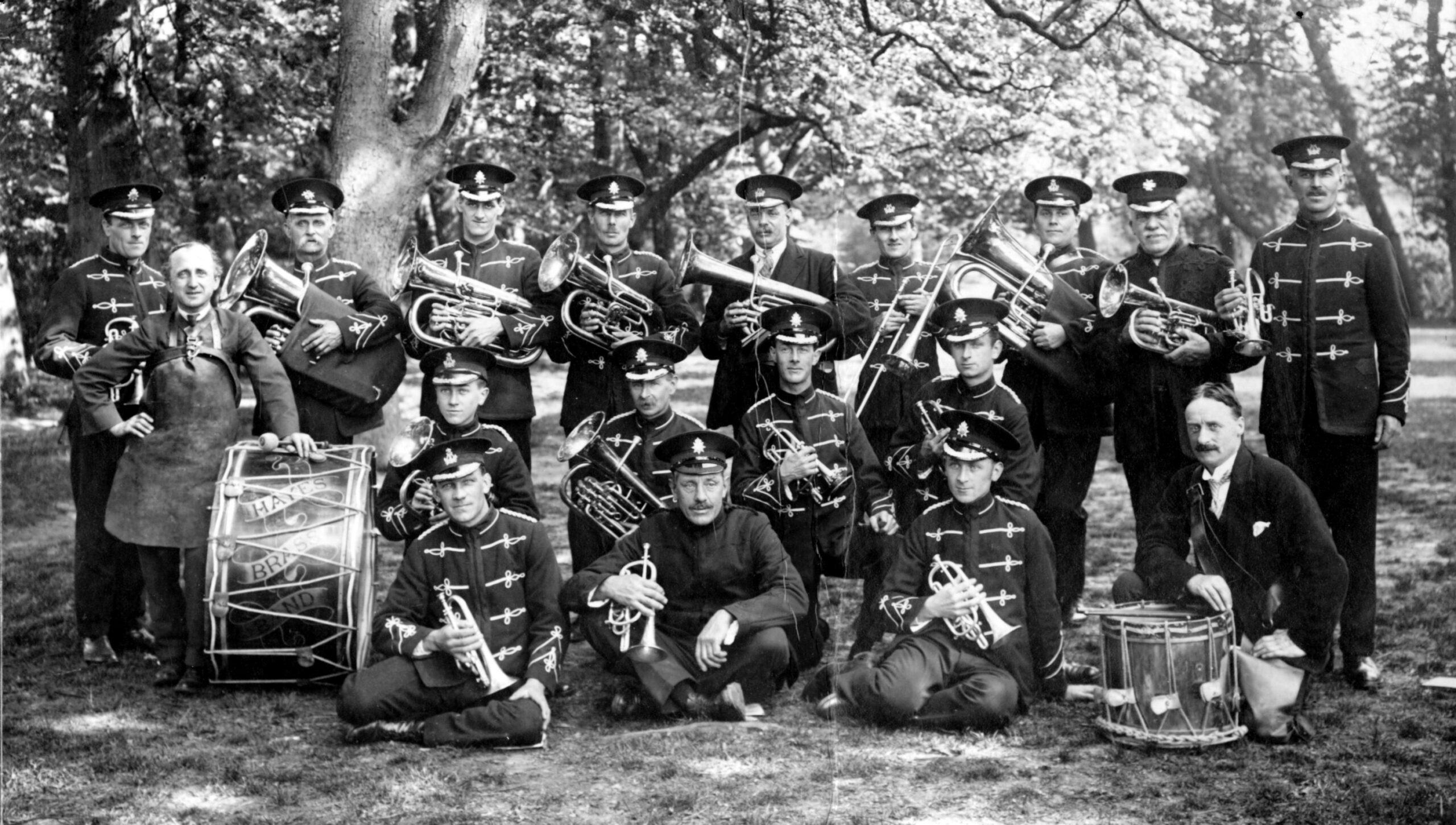
*The Hayes Brass Band played at major events
Several clubs struggled with membership, especially the Cubs who in 1925 had won the cup for the most efficient pack in the neighbourhood. Most of the older members had moved up to the Scouts.
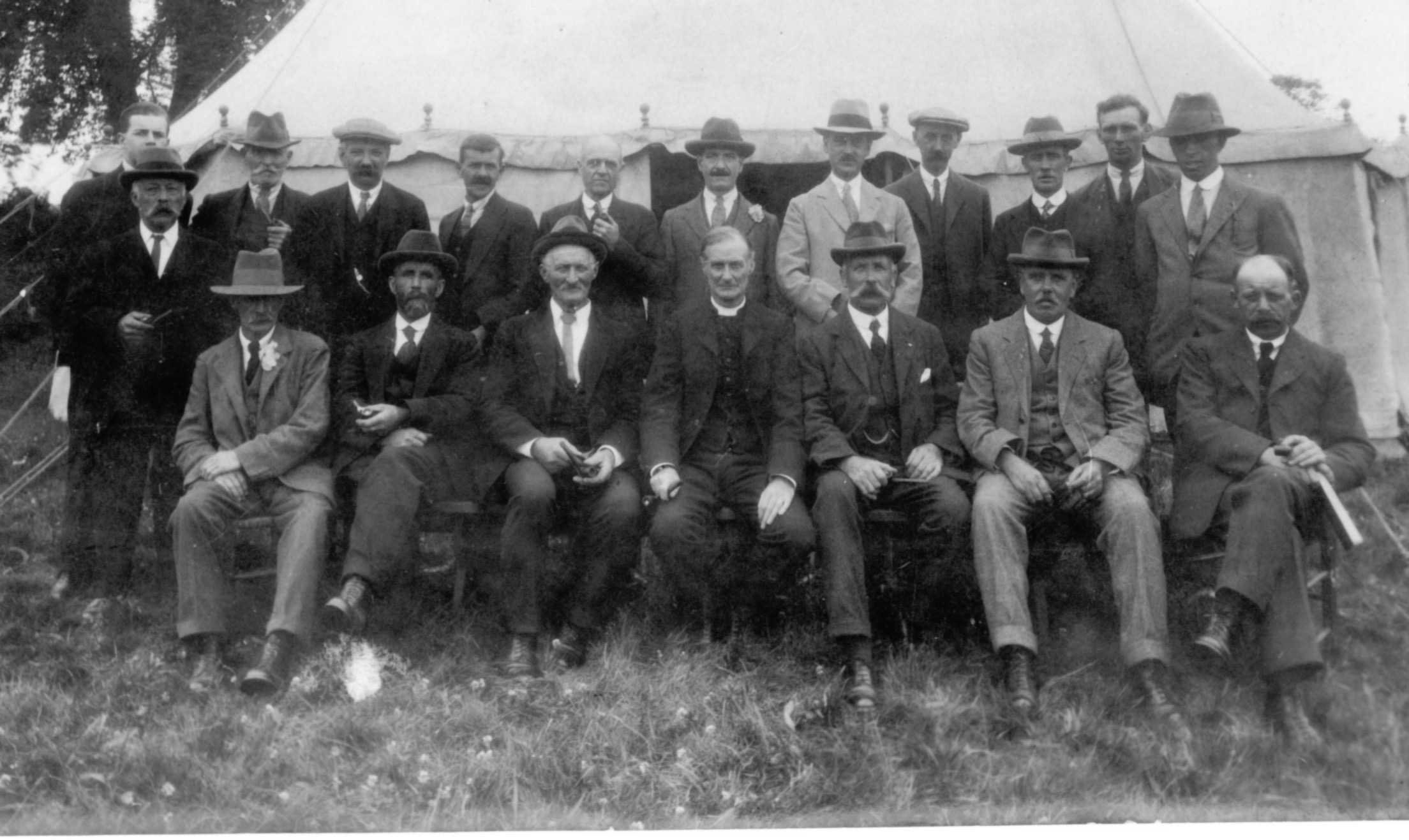
The Hayes Village Industrial Association, formerly known as the Hayes Cottage Garden Association, held its Annual Show and Open Sports Meeting, though attendance was lower than hoped. Douglas Haldeman had allowed them to stage the show on his land. He was a fellow of the Royal Horticultural Society, Master of the Worshipful Company of Gardeners and encouraged his gardeners at Gadsden to enter the competitions.
Sports Clubs
Hayes Football Club
Based at Baston Farm the club enjoyed its new pavilion, shared with the Cricket Club, built from the timber of the old rifle range. Player shortages were a challenge as many young men left Hayes for work, including the Captain, Frank Govier. In 1926 he continued to come from Streatham to Hayes for matches and also supported dances held to raise funds.
Hayes Cricket Club
Several fine Hayes cricketers had been killed in the First World War and efforts were made to recruit more players. Supported by its president Douglas Haldeman, the club enjoyed its new shared pavilion and welcomed returning summer visitors like the Birley family from Egypt.[History of Hayes Kent Cricket Club 1828-1878]. The maintenance of the cricket field was greatly helped in 1926 when young Roger Grandfield persuaded his father to allow him to use the family’s mower to cut the grass. He joined Bill Dance who helped his older brother James by pulling the roller to level the bumps on the cricket square. At the Cricket Club AGM in 1926 James was presented with a full cricket outfit in recognition of his services.
Pickhurst Cricket Club began but had similar difficulties in finding players. In July 1926 in a match against South Hill, Bromley they could only score 12 runs. A few weeks later Hayes Cricket Club was able to beat South Hill scoring 98 for 8 wickets
Tennis
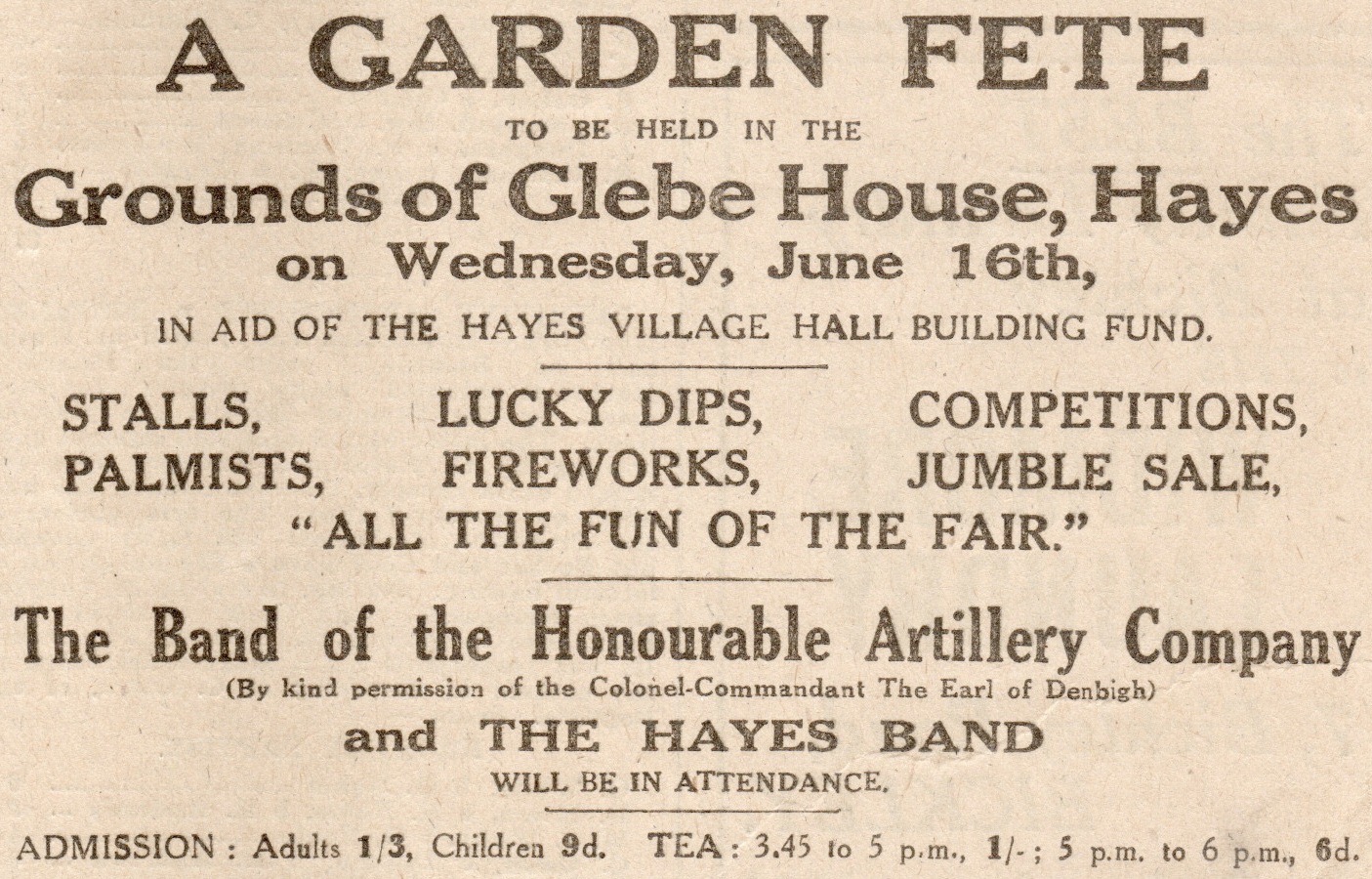
Several of the larger houses had their own tennis courts, At Glebe House James Frost arranged an exhibition match featuring Wimbledon Champion Kitty Godfree and her husband Leslie. Over 500 spectators helped to raise funds for the proposed Village Hall. A week later on Wednesday, 16 June, a successful Garden Fete was held in the garden for the same cause with stalls, fireworks, the Band of the Royal Artillery and the Hayes Brass Band.
Athletics
The Blackheath Harriers moved their headquarters to Bourne Way in 1926, establishing Hayes as a hub for cross-country running. The old buildings, formerly used by contractor Edwin Price, were leased from Arthur Steer of Woodgrange, Station Road for £850 and planning permission for new club premises approved in November. The club remained until 2023 when it moved to Norman Park, Bromley.
Hayes Nursing Association
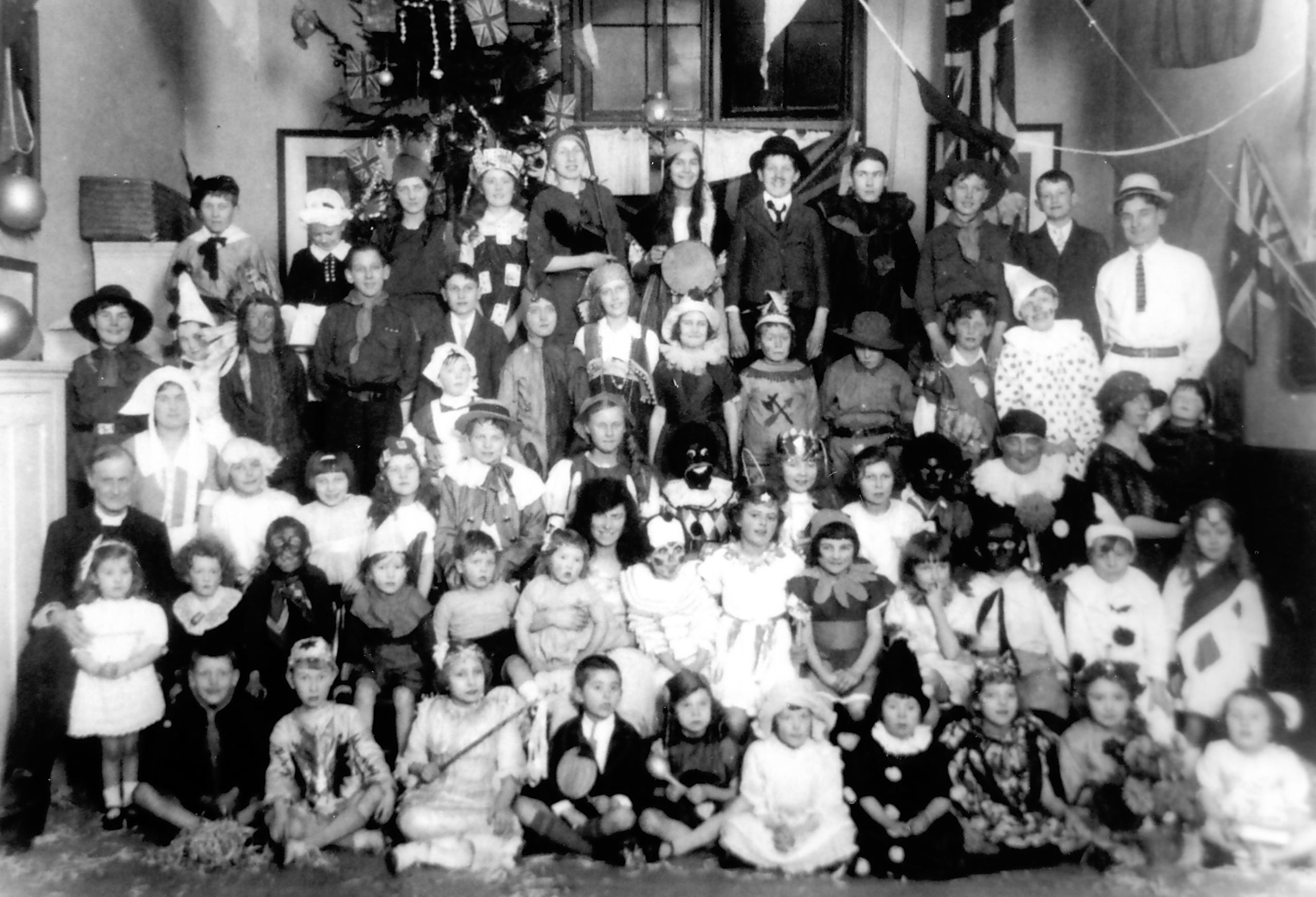
Before the NHS the Hayes Nursing Association, provided essential healthcare through donations and subscriptions. District Nurse Lee received £120 a year and accommodation. In 1926 she made 970 visits including midwifery, school health, minor injuries and general care. After the death of Sir Everard Hambro, the Association appealed for more donations to continue its work. The Annual Fancy Dress Party, held in the Village School, went to support its work.
Schools
Hayes Court School
The exclusive girls’ boarding school expanded significantly in 1926, adding classrooms, dormitories, a gym and a swimming pool, built by local builder G W Smith of Bromley Common. The new school hall was visited by members of the HCC as a possible design for the proposed Village Hall.
Students enjoyed visits from cultural figures including Virginia Woolf and Chief Oskenonton. At the beginning of 1926 there was a lecture from the author Virginia Woolf [Hayes Review No.257]. There was also the memorable visit of Mohawk Chief Oskenonton who famously demonstrated fire-making on the parquet floor.
Hayes National School
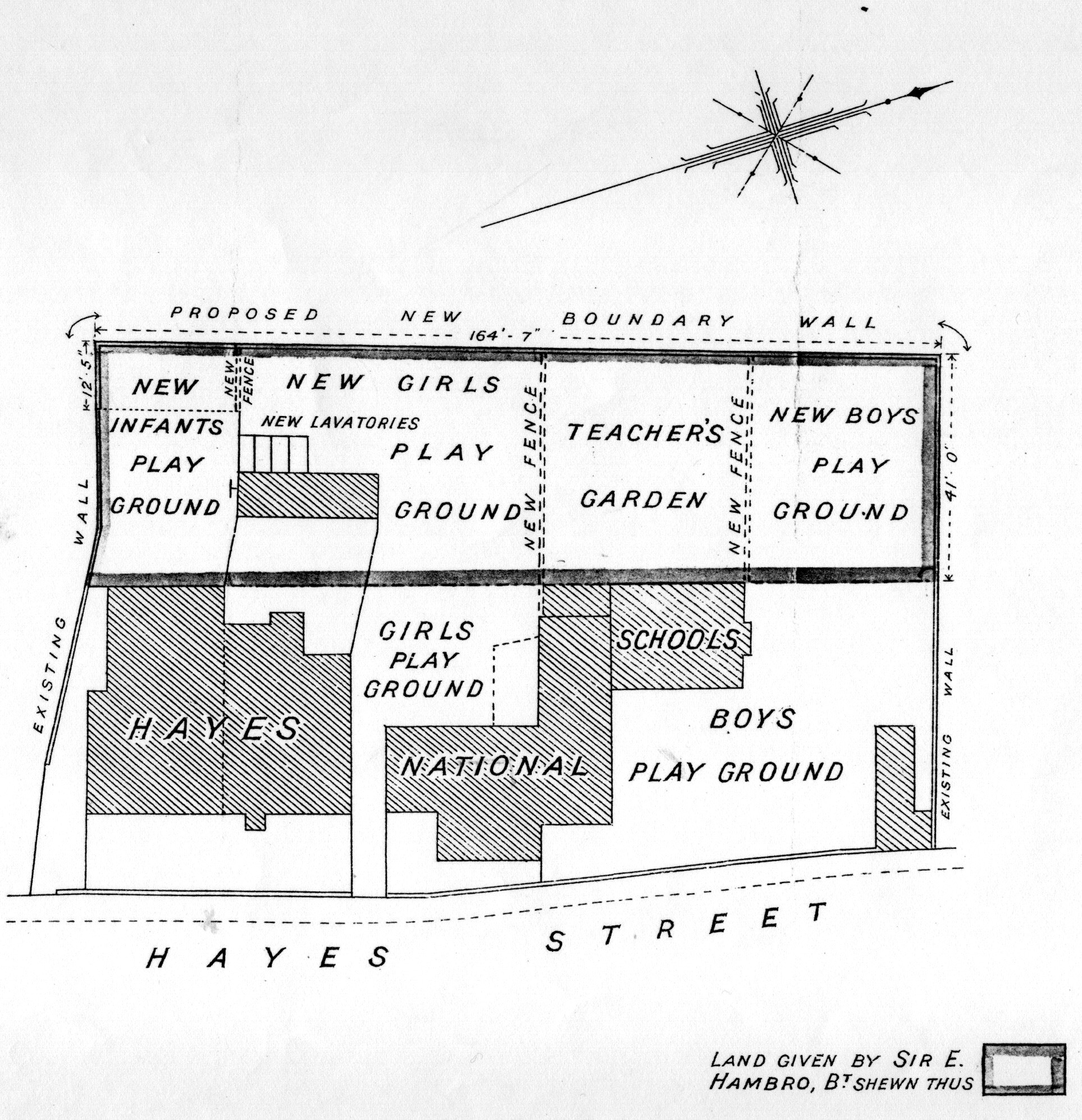
With around 90 pupils aged 4 -14, the school benefitted from Sir Eric Hambro’s gift of land to extend the playground – with strict conditions about religious and patriotic teaching. He also required a 6foot 6inch (1.98m) wall of either stone, brick or iron to be erected. In March 1926 an appeal was made for £250 to provide the equipment and by June £100 had been received,
Main events:
*Shortage of older girls and the Infants used the Cookery Room
*Older boys had woodworking classes in Keston
*Football and Netball were played on the Common
*Good Diocesan Report. Six of the older pupils entered and received distinctions in the Diocesan Religious Knowledge Examination
*Empire Day Celebration
*Christmas production of Yuletide Revels recreating the ‘Merrie England’ spirit
A Community Proud of its Heritage
Events and activities were fully reported in the local newspapers and many envied the community spirit that existed in Hayes. It was Canon Thompson who encouraged villagers to value their community and its history.
‘Thus we sing of Hayes and the good old days and those who have made us great.’
Let us long continue to appreciate the delights of the village of Hayes
Further information:
Hayes Parish, Bromley Rural District Council and Hayes Nursing Association Records – Bromley Historic Collections